Wednesday, 29 April 2015

Weekly What Bird Wednesday


Thank you for joining me for W.W.B.W. once again! Last week there was a substantial amount of guesses.  Josiah guessed right! It was a Northern Shoveler! Here is this week's picture!


Other W.W.B.W. posts*:
Birds In Your Backyard
Bird Boy
The Cats and the Birds

*Posts may not be up yet.

Tuesday, 28 April 2015

B.O.T.D. Gray Partridge

Gray Partridge (Perdix perdix)


birding.bc.ca
Native to western Eurasia, Gray Partridges were released in Canada in the early 1900s as game birds. Secretive and shy most of the year, the are rarely seen in the open. Watch for them in the morning or evening, when they venture onto quiet roads, or in winter, when they sometimes forage beneath rural bird feeders. When flushed a covey of will burst into flight, flapping furiously and dispersing in all directions, a tactic intended to confuse predators. Although Gray Partridges are relatively hardy birds, many parish in harsh weather, and some birds become trapped under layers of hardened snow while taking refuge from the cold.

The Gray Partridge has a high mortality rate and a short lifespan, but it makes up for these with its high reproductive capability. An average clutch size is about 16 eggs, and nests with more than 20 eggs are often found. When incubating her eggs, the female will sit tightly on her nest and risk being stepped on rather than attracting attention. 

Like other seed eating birds, the Gray Partridge regularly swallows small amounts of gravel to help crush hard seeds. The gravel accumulates in the bird's gizzard, a muscular pouch of the digestive. This bird was once known as "Hungarian Partridge," and coveys of Gray Partridges are still called "Huns" by many hunters and birding enthusiasts.

Reader's Digest Publications: Birds of Canada

Monday, 27 April 2015

Killdeers

We have an abundance of Killdeers at my house and they were scratching at the dirt beside the driveway... making a nest? Here are some photos...


The tail

Digging


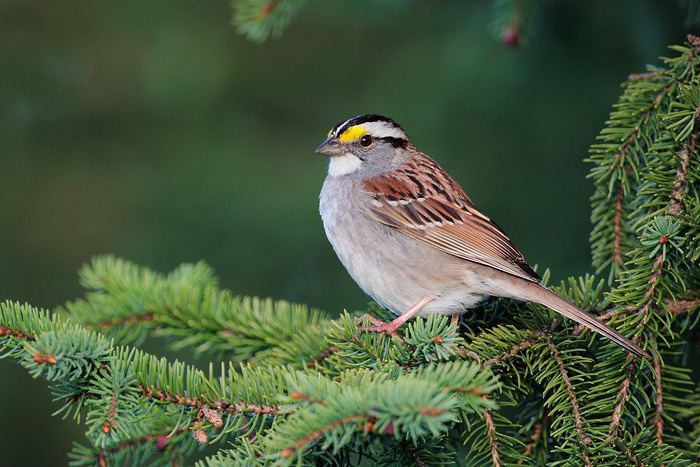
B.O.T.D. White-Throated Sparrow

White-Throated Sparrow (Zonotrichia albicollis)


Tringa.org
The white-throated sparrow's song may not be the most glorious of sparrow melodies, but it is probably the best known simply because more people hear it. Although white-throats nest chiefly across the rural expanses of Canada, they winter through much of the eastern and southern United States - and they sing all winter long. They sometimes seem to be singing absentmindedly, it's true, but from March into May, when the last migrants leave, white-throats sing with real energy and purpose.

Their song is a simple one, often imitated by birders, and a passable rendition of it will bring the birds flitting through bushes in curious interest, craning their necks and peering about with bright eyes to discover the new arrival with the strange accent. White-throats and other small birds can also be called by "squeaking" - a sound make by a person kissing the back of his hand. Because the sounds are like those of a baby bird in distress, this kind of calling works especially well during the nesting season: parents come flocking, and birders have a chance to see species they might otherwise miss. But, understandably enough, squeaking also upsets the birds and can disrupt the care of their fledglings. Needless to say, therefore, it is a technique to be used with restraint and common sense.

Reader's Digest: Book of North American Birds 

Friday, 24 April 2015

Lockport

Today, as we had a day off from school, our family went on a day trip. We went through several towns and finally ended up at Lockport. Here are some Pelican pics from the trip.


To see my sightings go to the Friday Part 1Friday, Part 2, or Friday, Part 3

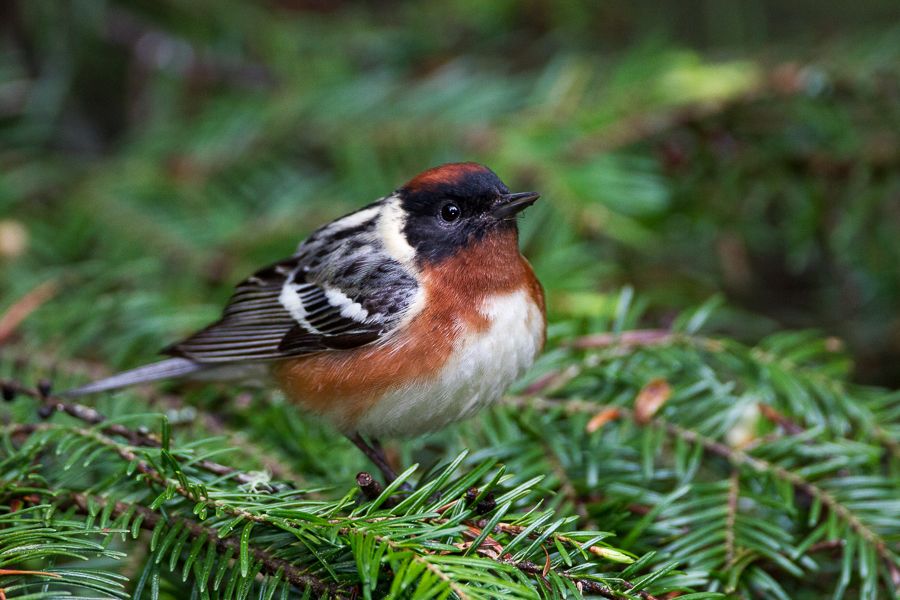
B.O.T.D. Bay Breasted Warbler

Bay-Breasted Warbler (Dendroica castanea)


There's nothing like a plague of spruce budworms to make this warbler's day. Such outbreaks occur cyclically in northern conifer stands where the bay-breasted warblers nest, and can denude vast tracks of spruce and fir. Inflicting the damage are voracious budworm larvae, pests that have been a bane of lumbermen since the early 1900s. Bay-Breasted Warblers often react to the infestations by creating a population boom of their own making to take advantage of the sudden insect bounty.

Showing true team spirit, nesting bay-breast scale down their normal territorial requirements so that more of their kind can squeeze into a budworm-infested area. The prodigious appetites of the additional nestlings are satisfied by an abundant supply of this protein-rich food. The number of bay-breasted warblers produced during such years sometimes exceeds six times the region's annual norm.

Inevitably, the budworms begin eating themselves out of house and home, and the infestation subsides or ends abruptly. Bay-Breasted Warblers, whose numbers have swollen to peak levels during the budworm explosion, find slim picking after the decline. As a result, their numbers, too drop to normal levels, and a more stable bird-insect balance returns to the northern woodlands.

Reader's Digest: Book of North American Birds

Thursday, 23 April 2015

B.O.T.D. Red Knot

Red Knot (Calidris canutus)


Imagine a beach so densely packed with shorebirds that sunlight is blocked from the sand. If that beach were on Delaware Bay in mid-May, the shorebirds - numbering in the hundreds of thousands - would be red knots.

Separating New Jersey from Delaware on a coastline pressured by rapid suburban growth, Delaware Bay serves migrating knots as a crucial stepping-stone. En route to the Arctic from their South American wintering grounds, these chunky "beach robins" time their arrival to coincide with the breeding cycle of the bay's horseshoe crabs. Every May hordes of these ancient invertebrates haul themselves from the surf to deposit eggs by the millions in holes they have scooped in the sand. Knots, ruddy turnstones, and other shorebirds depend on these eggs to refuel their northward flights. The birds stay several weeks, gorging on the eggs from dawn until dusk to increase their body weight by 40% or more. Finally sated, they whirl off again in huge clouds toward the Arctic.

How many birds can convene on Delaware Bay? During the month of May alone, a million birds may comb the bay's egg-laden shores. On a given day during that period, more than 80% of North America's Red Knots - and half its ruddy turnstones - may join ranks there in one of the world's most awe inspiring congregations of wildlife.

Reader's Digest: Book of North American Birds

Wednesday, 22 April 2015

Weekly What Bird Wednesday

Thank you for joining me for W.W.B.W. once again! Last week there was a substantial amount of guesses. Bird Boy and Grietje guessed right! It was a Fox Sparrow. Here is this week's clue:

Male bird has a deep green head with large wide black bill with chestnut sides and white breast and belly. It has a blue speculum.

Other W.W.B.W. posts*:

Birds In Your Backyard
Bird Boy
The Cats and the Birds

*Posts may not be up yet.

Tuesday, 21 April 2015

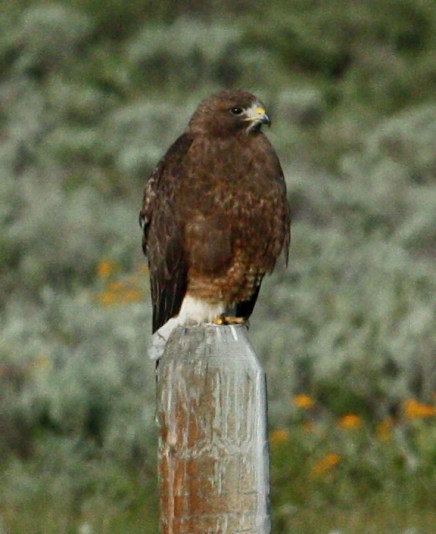
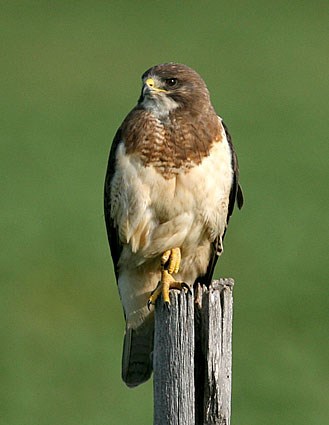
B.O.T.D. Swainson's Hawk

Swainson's Hawk (Buteo swainsoni)


The farmer directs the mower through his field. Crickets and grasshoppers spring for safety as he passes. In the wake of the tractor, where the blades have passed and the grass is cropped short, a dozen russet-bibbed birds scramble and dance. Are they injured? Hardly. The birds are reaping the bounty of insects and small rodents exposed by the mower. The farmer does the work. The Swainson's hawk repays him for his kindness by consuming the creatures that consume his crops.

Light Morph
Among the world's long-distance champions, Swainson's hawks nest as far north as Alaska and winter on the plains of Argentina. In March, Swainson's hawks by the thousands pour across the Rio Grande from Mexico into Texas. When evening comes, the great flocks descend. In the morning, when the sun begins drawing thermals aloft, the birds rise up: dozens, scores, hundreds, thousands of Swaison's funnel skyward. The swirling tornadoes of birds sweep north and fan out across the western states. As the miles and the days fall behind, the great migratory flocks diminish. One by one, the birds reach their nest sites across the western United States and Canada. The business of raising young consumes the summer; by August the task is done, and the birds turn southward. Another exodus of these endurance champions has begun.

Reader's Digest: Book of North American Birds

Monday, 20 April 2015

B.O.T.D. Hoary Redpoll

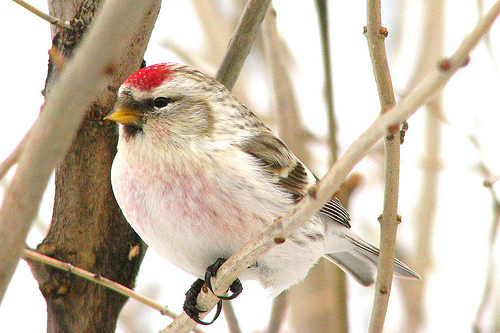
Hoary Redpoll (Acanthis hornemanni)


Common Redpolls and Hoary Redpoll can be confusing to differentiate because they look alike, share similar ranges and have similar songs and calls. The Hoary Redpoll is almost always seen with flocks of Common Redpolls and is generally paler and less streaked, with a stubbier bill. Some Hoary Redpolls are nearly impossible to differentiate from Commons, however, because of individual  variation within both species and some overlap in identifying features. Both redpoll species are remote northern nesters and "predictable unpredictable" winter visitors to southern Canada. Like many finches, they can be abundant one year and almost absent the next. In the south, they tend to be more abundant every second winter, reflecting cyclic lows and highs in seed availability in their normal (northern) range. Things were much simpler when the two redpolls were considered a single species.

Redpolls are widely  adapted to life in the cold. They have a high level of food intake, in part because of a special storage pouch in the esophagus (the esophageal diverticulum), which allows them to carry large quantities of energy-rich seeds.

Lone Pine Publications: Birds of Canada