Tuesday, 31 March 2015

The Forks

We went to the Forks today and got some good photos... here are a few. While we were there we caught many birds flying to and from nests with twigs, we didn't get any pictures but the one below is from one of the nest-sites-to-be.
House Sparrow Nest Site, Male is just visible inside.
Male House Sparrow

Male and Female House Sparrow

Male House Sparrow

Canada Goose

Canada Goose

Canada Geese getting aggressive

Canada Goose

Canada Goose

Canada Goose Close Up

Canada Goose Head On
Ring-Billed Gull Foraging

Aggresion... Canada Goose

Time for a Swim... Canada Goose


(J)

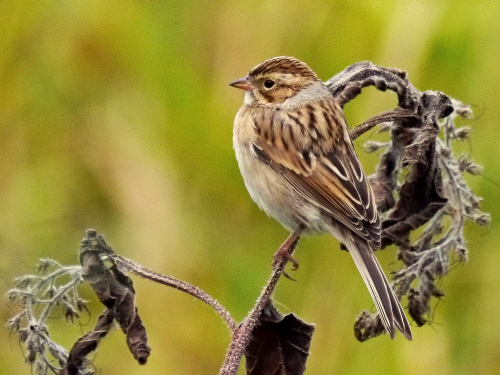
B.O.T.D. Clay-Colored Sparrow

Clay-Colored Sparrow (Spizella pallida)


At first glance it seems that when nature's treasures were being distributed among North America's birds, sparrows in general (and the clay-colored in particular) must have waited near the end of the line. Next to the party-dress finery of the wood warblers, sparrows seem to be outfitted like chain-gang workers, clothed mostly in a blend of uniform grey and commonplace brown. As songsters, too, they are far behind the music hall voices to orioles, or the exquisite, liquid calls of thrushes. The clay-colorer sparrow typifies the generally undistinguished musicianship of the sparrow family, announcing himself with a sonorous, insect-like call of three or four buzzes.

For all these seeming drawbacks, however, there is nothing hand-me-down about this bird. Perched atop a bush on a summer morning, this little sparrow has an unmistakable gentrified air. Its soft grey and crisp brown feathers are subtly woven like a fine English tweed, well cut  and expertly fitted. The younger birds wear a warm, buff-brown sweater with a grey collar before growing into the tweedy look, and both parents tend to their welfare in the meantime. The male sometimes feeds his mate while she nests, and the female is an adept impersonator, luring predators away from her hatchlings by feigning an injury that promises an easy meal - but hardly ever delivers it.

Cornell Lab: Clay-Colored Sparrow                                                         Reader's Digest: Book of North American Birds

Monday, 30 March 2015

A New Month and March in Review

Two local Canada Geese
This month was a fruitful month once again! Thank you all for following this blog, by the way! This month was fun, especially counting all the geese you could see in one day... the best so far is 351 by Joel. Lifers included the California Gull... a rarity also along with a Swainson's Hawk early this season. Today, also, the first meadowlarks showed up! Meadowlarks are among my favourite of birds, and thankfully, they are abundant at my place! Don't forget to watch my bird log for updates on what is happening.

Thank you!

Photo Contest!

We are starting a new photo contest! Every two weeks we will judge the photos you send us and the winning photo will be put up for public viewing on our blog with the link to your website! A little free advertising! Send your entries to our email at jcbirds09@gmail.com
TELL YOUR FRIENDS!

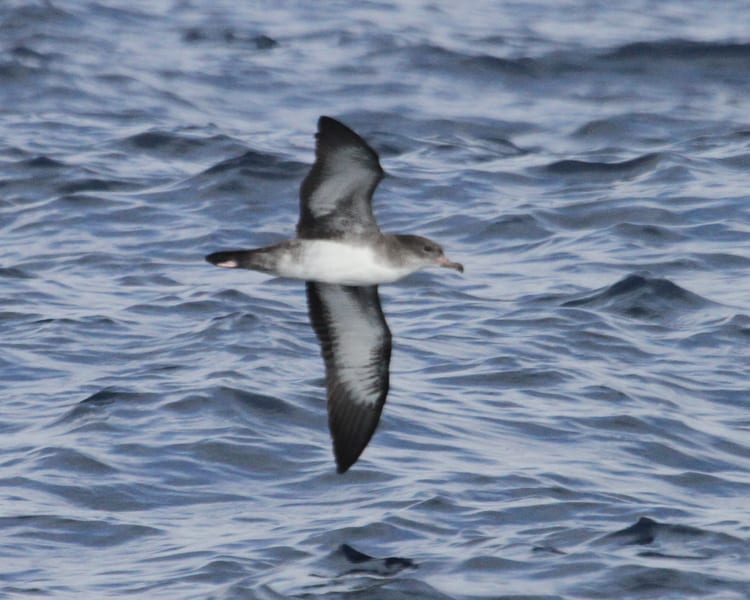
B.O.T.D. Pink-Footed Shearwater

Pink-Footed Shearwater (Puffinus creatopus)


Shearwaters are long-winged seabirds that fly with shallow, rapid wingbeats and stiff-winged glides. Outside the breeding season, Pink-Footed Shearwaters are birds of the open ocean, generally seen on land only infrequently. Among swarms of other shearwaters encountered at sea from April to November, the Pink-Footed Shearwater is second only to the Sooty Shearwater as the most common shearwater off Canada's Pacific Coast. Although they tend to stay well off-shore, small numbers of Pink-Footed Shearwaters may be seen  from strategic coastal locations with the aid of a telescope.

Once their nesting duties are complete, Pink-foots migrate north along the continental shelf in search of large schools of fish and squid. They prefer to forage along the edge of the continental shelf where upwellings of cold water occur and marine life is plentiful. As is true with other members of the shearwater family, Pink-Foots assemble with astonishing quickness at any food source. They will closely approach any boat if food of any description is tossed overboard. They regularly dive up to three meters below the surface to catch prey, and have even been known to dive to depths of 25 meters in pursuit of food.


Reader's Digest Book of North American Birds

Friday, 27 March 2015

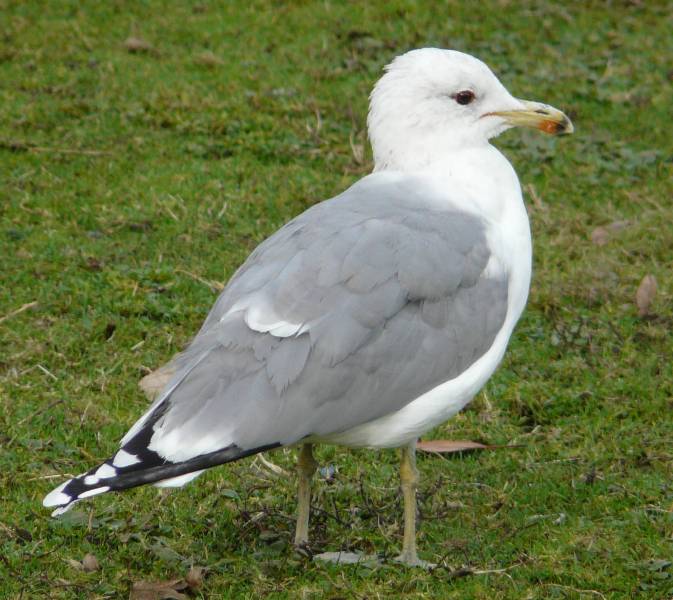
B.O.T.D. California Gull

California Gull (Larus californicus)


In the heart of Salt Lake City, Utah, stands a monument to sea gulls that commemorates their contribution to the Mormon's settling of the surrounding area. To many visitors, such a landmark must seem somewhat puzzling.

The term "sea gull" is often a misleading one, for many gulls spend much of their lives far from the ocean. The California Gull - itself somewhat misnamed - breeds primarily on islands in lakes of the interior plains of the West. This opportunistic feeder not only plunges after lake fish but also takes cutworms, grubs, small rodents, and other agricultural pests in freshly plowed fields - habits that make it welcome to farmers. Indeed, to the first Mormon settlers in Utah, the California gull seemed to be divinely sent.

In 1848 and again in 1855, plagues of grasshoppers broke out in Salt Lake Valley and threatened to destroy the settlers' crops, which would have meant almost certain starvation. But as one newspaper reported, "the gulls made war on them, and have swept them clean." In 1913 the Mormons erected their monument to that event, and the California full, almost certainly the species that came to the rescue, is honoured now as the state bird of Utah.

Cornell Lab: California Gull


Reader's Digest: Book of North American Birds

Thursday, 26 March 2015

B.O.T.D. Gray-Headed Chickadee

Gray-Headed Chickadee (Poecile cinctus)


The Gray-Headed Chickadee, also known as "Siberian Tit," breeds throughout  northern Europe and Asia, from Norway eastward to northwestern North America. In Canada, the Gray-Headed Chickadee is primarily found north of the Arctic Circle in northern Yukon and northwestern Northwest Territories. Gray-Headed Chickadees are generally sedentary, though some populations become nomadic during winter months. Like other chickadees, they form mixed-species flocks with other passerines outside the breeding season. The female excavates and constructs the nest while the male guards against rival males and predators. During incubation, the male feeds the female, who remains on the nest throughout the incubation period. Each birds stores as much as  3 Kilograms of food in cavities, holes, and under bark to help it through the frigid, dark winters.

The Gray-Headed Chickadee can be distinguished from the similar Boreal Chickadee by its greyer cap, extensive white cheeks and dusty flanks. Juvenile Boreal Chickadees have a greyer crown and hoarser voice than adults and are sometimes misidentified as Gray-Headed Chickadees. Although the Gray-Headed Chickadee is rare but apparently stable in Canada, populations in Eurasia have declined considerably because of human disturbance and especially logging.

Lone Pine Publications: Birds of Canada

Wednesday, 25 March 2015

BIRDS FROM THIS SUMMER

Check out the new BIRDS FROM THIS SUMMER post at: Birds From This Summer

Game On!

Hello it is us again! A contest has been proposed by Josiah that me and him should do a contest to see who can see the most species of birds this year. So far I am beating him by one species! Best of luck to both of us. We have invited Jo's brother William and my partner in JC Birds+ to join. I am in the lead! If you have suggestions where to go for optimum birding tell us! Also I have a goal this year of adding 15 species to my life list! Lets go!

Also follow my bird log to follow my progress! I will indicate a lifer with the word lifer in brackets.

You are on my blog now so feel free to comment! To see Josiah's click this link: Birds In Your Backyard

What is the prize? BRAGGING RIGHTS!

(J)

Weekly What Bird Wednesday

Thank you for once again joining me for W.W.B.W. Last weeks bird as Bird Boy, Josiah, and William all guessed was an American Bittern. Here's this weeks clue:

I belong to a family of bird that pecks at trees. Although not named as the other more common in my family I still fit in. The male has a red crown and throat with a black and white striped head. There is  a yellowish tint to his breast and stomach.

Other W.W.B.W. posts:*

Birds In Your Backyard
Bird Boy
The Cats and the Birds

*The posts may not be up yet as this post is set to post at 6:30 Central Time.