Friday, 27 February 2015

B.O.T.D. Gray Jay

B.O.T.D. Feb 27, 2015

Gray Jay (Perisoreus canadensis)


The gray jay is a bold bird, equipped for survival in the harsh North Woods. No stranger there to humankind, it has many names - camp robber, moose bird, and meat bird among them - each reflecting the bird's relationship to people and its environment. Indians call it wiskedjak, from which whiskey-jack, one of its most common names, was taken. In Algonquin-Ojibwa lore, the sly Wiskedjak is the gray jay in human form. In real life, the large chickadee lookalike both vexes and entertains. For if pilfering defines the family, the the whiskey-jack is the quintessential jay. Campers soon learn that all food is the fearless bird's prey; indeed  it may boldly alight on a plate or a frying pan to filch a tasty morsel. Hunters, too know that the sound of a gun will bring the gray jay, eager for moose or deer meat. The Indians sum up by declaring that whiskey-jack will eat anything, including moccasins and fur caps.

The bird's opportunistic behaviour is not purposeless. It is storing food and fattening itself against the long northern winter, when it may have to eat lichens for fir needles, and when its biological clock will impel it to begin nesting in late February or early March. With snow on the ground and subzero temperatures keeping it close to its eggs in a feather-lined nest, the gray jay will need secret stores, perhaps of tidbits of bacon and hash-browned potatoes as well as the berries and nuts stored away during summer's halcyon days.

Thursday, 26 February 2015

B.O.T.D. Black-Necked Stilt

B.O.T.D. Feb 26, 2015

Black-Necked Stilt (Himantopus mexicanus)

Long ago nicknamed the lawyer bird (for its persistent noisiness during the mating season), the black-necked stilt was, like many other wading birds, hunted nearly into extinction in the 19th century. Fortunately, lawmakers intervened in time to allow most of the threatened species to recover. Now the black-backed stilt is seen often its favourite breeding areas in the south and west.

And it is a memorable sight, making its feeding forays into both fresh and saltwater ponds atop the exceptionally long legs for which it is named - perhaps the longest in relation to body size of any bird's. The black-necked stilt is also a master at assuring its own air-conditioning during the breeding season. It keeps its ventral feathers wet by making as many as 100 trips daily from the nest to the nearest water, so that evaporation will help cool the parent, its eggs, and eventually its nestlings. Without such a cooling system, a female stilt could perish while spending an especially hot day motionless on her nest.

Breeding in a variety of locales - moist savannahs, pond edges, marshes, and fields with a history of flooding - back-necked stilts may form colonies of about 40 pairs. When all are busy fishing, their long legs bent in shallow waters and needle-line bills poised for action, they form an almost dreamlike silhouette against sunset or dawn.


Wednesday, 25 February 2015

B.O.T.D. Nashville Warbler

B.O.T.D. Feb 25, 2015

Nashville Warbler (Vermivora ruficapilla)

Alexander Wilson, who discovered this species near Nashville, Tennessee, in 1811, saw but three specimens in his lifetime. John James Audubon, during his long and well-travelled career, chanced upon only four. Yet by 1879 another eminent ornithologist, John Krider, reported the bird to be "very abundant as far as Minnesota." What had happened? A great deal, as Americans moved west, clearing forests, cultivating the land, then abandoning it. Today, the Nashville warbler is a common resident of second-growth northland woodlands and spruce bogs, its ground nest hidden in grass beneath low brush or nestled within some snug, mossy nook.
In its primary haunts, below a shaded canopy, the bird's bray-green plumage is muted. Were it not for bright, active song and an unquenchable restlessness, the Nashville would hardly warrant any attention at all. But catch one in the open, in a shaft of sunlight leaking through the leaves, or against the raven-green of a wall of spruce, and its plumage comes alive. Yellow underparts gleam, the love back ripples with hidden colour, and the pearl-gray head makes a perfect completion to the overall design.

During migration, the Nashville warbler my be found over much of North America in a variety of settings. It can even be found in the parks and gardens of the city after which it was named, though it appears there only in transit, passing through with the changing of the seasons.

Tuesday, 24 February 2015

B.O.T.D. Mountain Quail

B.O.T.D. Feb 24, 2015

Mountain Quail (Oreortyx pictus)

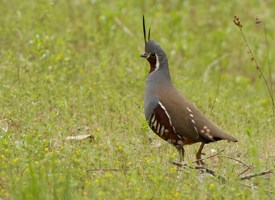
Very much creatures of the western mountains, these largest of our North American quail are noted for their seasonal movements up and down the slopes. Their journeys are not long - just 20 to 40 miles or so. But, surprisingly, the birds travel every inch of that distance on foot.
Far from being a forced march, the trek more closely resembles a leisurely jaunt. In spring and summer, mountain quail nest and rear their young in undergrowth along the foaming streams of high mountain glens at elevations  ranging from 1500 to 10000 feet. Then, in late summer and early fall, the birds move gradually down the slopes to lower valleys and canyons, where they escape the extremes of high-altitude winter weather. When spring returns, they go up the mountains again, striding on sturdy legs, feeding and conversing, resting and roosting along the way.

Mountain Quail can fly, of course. Like other quail, they have short rounded wings that are arched and strong for quick takeoffs - from the ground into full flight in just an instant. But for the most part, whether seeking safety beneath the almost impenetrable brushy cover in which they live or traveling long distances, they seem to prefer to walk or run. 

Monday, 23 February 2015

B.O.T.D. Blue-Winged Warbler

B.O.T.D. Feb 23, 2015

Blue-Winged Warbler (Vermivora pinus)

The scientific name may be Vermivora pinus, but evidently the blue-winged warbler does not read Latin, because it has no connection with pine woods at all. Second-growth woodlands and overgrown fields afford a natural home for this bird, whose head and underparts gleam like buttercups in sunshine. Methodically, unhurriedly, the Blue-Winged Warbler ambles through thick foliage, picking off a caterpillar here and gleaning a spider there. At times it may dangle upside down like a chickadee or titmouse, but this matter-of-fact feeder seems to have none of the flash of other members of the warbler family.
Where ranges of blue-winged and golden-winged warblers overlap, interbreeding occurs, and the young inherit traits of both parents. The classic hybrid types have even been given their own names - the Brewster's Warbler and the less common Lawrence's Warbler. These hybrids are fertile and may interbreed with either parent species, or with still other hybrid birds.

With so  much mixing and matching, a basic question occurs: are blue-winged and golden-winged warblers really different species at all? The question may not be asked for long. Where ranges overlap, blue-wings generally increase and golden-wings decline, the victims of genetic swamping. Eventually, golden-winged warblers may simply disappear, their identity diluted to the vanishing point within the blue-wings genetic pool.

Friday, 20 February 2015

Hello, sorry I missed bird of the day for the last two days. We had some safety issues with the blog so we put it under maintenance for the last few days. Sorry about the inconvenience and thanks for the cooperation.

Wednesday, 18 February 2015

B.O.T.D. Black-Capped Chickadee

B.O.T.D. Feb 18, 2015

Black-Capped Chickadee (Poecile atricapillus)

When nesting is over and the young are on the wing, black-capped chickadees form flocks of eight to a dozen birds, which will roost and forage together until spring. Finding food in the winter is often tough, and hunting for it in groups increases the chances for success. As a band of chickadees flits among the trees and shrubs searching for insect eggs and pupae, they keep an eye on on another. When an individual discovers a tidbit, its fellows not only renew their search with enthusiasm, but concentrate on the particular niche where the discovery was made. In this way, new food-source bulletins are continually disseminated thought the company.
So many eyes provide extra notice of danger as well. The first chickadee to spot a predator gives a warning note and then whole flock freezes, then utters thin, ventriloquial notes. The predator, confused by the disembodied calls coming from every direction and no direction, is typically unable to initiate a hunt. When it moves on , an "all's well" note brings the flock bak to life.

Birders scrutinize fall and winter chickadee flocks, knowing that other species, such as titmice, nuthatches, kinglets, warblers, and creepers, often travel with them. While the accompanying birds may not swan to tap into the food information system, they appear to benefit from the predator-defence.  

Tuesday, 17 February 2015

B.O.T.D. Killdeer

B.O.T.D. Feb 17, 2015

Killdeer (Charadrius vociferus)

At least two days before killdeer babied peck their way out of their shells that are conversing in peeps and learning to understand the voices of their parents. When at last they kick the shells aside - usually within an hour or so of one another - they are wet and exhausted from the hours long struggle. Their parents brood them to keep them warm and help them to rest. A few hours later their down is dry, their eyes are open, and their are following their parents from the nest, looking like mottled brown puffballs on toothpick stilts.

Soon they begin picking at the earth with their own small bill, finding out for themselves that they can eat the seeds and tiny insects that lie there. But danger is all around. At the slightest sign from their parents they lose their dark eyes and freeze in place, not twitching a muscle, while their parents fly into the faces of cattle ambling toward them or try to lead more determined enemies away be pretending to be crippled. But if the parents signal them to flee, the chicks dash away, sometimes into a stream or pend where they seem away. If the predator is a hawk, they drop beneath the surface and win safely underwater.

Finally, after almost a month of learning about land and water, the youngsters grow flight feathers and join their fellows in flying and screaming happily above the pastures.  

Monday, 16 February 2015

B.O.T.D. Sky Lark

B.O.T.D. Feb 16, 2015

Sky Lark (Alauda arvensis)

Few birds have inspired more people with their songs than the Sky Lark. In 1820, poet Percy Bysshe Shelley wrote "...That from heaven or near it / Pourest thy full heart / In profuse strains of unpremeditated art." The Sky Lark's continuous warble, delivered high in the air and lasting up to 30 minutes for a completed song, is the longest of any North American bird.

The Sky Lark was introduced to southwestern British Columbia from Great Britain in 1903. The Fraser River delta population failed, but birds on southern Vancouver Island fared better. After a few more birds were released, small numbers became well established, and by the 1960s, their heyday, Sky Larks were a common sight around Victoria and on the Stanch Peninsula to Sidney. By the mid-1990s, there were fewer than 100 birds remaining on Vancouver Island and the San Juan Islands in Washington. Loss of breeding and foraging habitat to decreased urbanization and land use changes appears to be the main reason for ongoing declines of the Sky Lark. Birders from around the world visit southern Vancouver Island to add the species to their North American list, but the Sky Lark could be extirpated from Canada in our lifetime.

Friday, 13 February 2015

B.O.T.D. Black-Headed Gull

B.O.T.D. Feb 13, 2015

Black-Headed Gull (Chroiocephalus ridibundus)

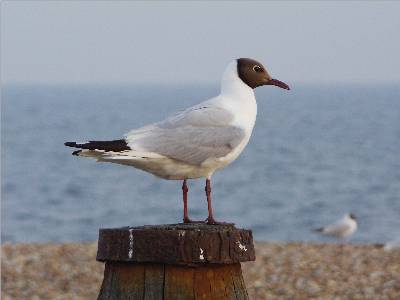
Black-headed Gulls are a regular, and increasing, attraction for birders in Atlantic Canada. The odd one out can be found cavorting with large gatherings of Bonaparte's Gulls in autumn, and numbers increase after their smaller relatives leave. The often-raucous concentrations of gull in Newfoundland's harbours and field roosts usually have a small number of these wanderers. This gull is also a rare visitor to the Great Lakes region during migration.

The Black-Headed Gull is a relative new-comer to Canada. The first sighting in North America was recorded in the 1920s, and the first Canadian nesting record occurred in 1977. Since then, small nesting colonies have been established on islands off the coast of Newfoundland, Nova Scotia and Quebec, and it may be just a matter of time before the species nests in Ontario.

In North America, there are many gulls with black heads. Ironically, the Black-Headed Gull has a chocolate brown head, which can easily be mistaken for black in the misty conditions that sometimes envelop Atlantic Canada's coasts.